The Psychology of Scent: Why Fragrance Is the Most Powerful Sense in Your Home
Aromawave Editorial • The Science of Scent • Australia
You walk into a room and something shifts immediately. The air has a particular quality. A feeling arrives before you have had time to identify what caused it. This is not imagination. It is neuroscience. And understanding why it happens will change the way you think about your home forever.
Of all the senses available to us, smell has the most distinctive direct pathway to the brain regions involved in memory and emotion. This helps explain why scent often feels so immediate and emotionally powerful, arriving as a feeling before the conscious mind has had time to identify or name what it is smelling.
This single anatomical fact explains why fragrance is so powerful in the home environment. It explains why walking into a beautifully scented room creates an immediate and distinctive impression. It explains why the scent of a five-star hotel lobby stays with guests long after checkout. And it explains why deliberately choosing and running the right fragrance through your home is one of the most impactful and psychologically meaningful decisions you can make about the environment you live in.
This guide is a purely educational exploration of what researchers and neuroscientists have discovered about the psychology of scent. It covers how the olfactory system works, why scent creates such powerful and lasting emotional impressions, what the research tells us about scent and memory, and how you can use this understanding to create a more intentional and considered home fragrance environment.
Educational note: This guide presents general neuroscience and psychology research about the human olfactory system. It is purely educational. Aromawave fragrance oils are luxury scent products designed to create a beautiful fragrance atmosphere in your home. No health, therapeutic, or medicinal claims are made about any Aromawave product in this guide.
How the Olfactory System Works: The Direct Route to Emotion
When you inhale a fragrance, airborne molecules enter your nasal cavity and bind to specialised receptor cells in the olfactory epithelium, a small patch of tissue located high in the nasal passage. These receptors send signals directly to the olfactory bulb, a structure at the front of the brain that sits immediately adjacent to the amygdala and the hippocampus.
The amygdala is the brain's primary centre for processing emotion. The hippocampus is its primary centre for storing and organising long-term memory. Because the olfactory bulb connects directly to both of these structures, a fragrance creates an emotional and memory response almost instantly, before the brain has had time to consciously identify, name, or analyse what it is smelling. This is why scent-triggered responses so often feel involuntary and immediate. They are.
Sandeep Robert Datta, a professor of neurobiology at Harvard Medical School, has described the original brain as essentially a combination of a sense of smell, a sense of navigation, and a sense of memory working together. Our earliest neural architecture evolved around olfaction. Long before language, rational thought, or visual processing reached their current complexity, smell was the primary sense through which our ancestors navigated the world, identified safety and danger, located food, and recognised familiar individuals. This evolutionary heritage is why scent retains such an unusually direct and powerful connection to the most fundamental emotional and memory systems in our brains.
How Scent Reaches the Brain: The Pathway
| Fragrance molecules inhaled | Enter the nasal cavity and bind to olfactory receptor cells |
| Olfactory bulb activated | Signal travels to the olfactory bulb, which has close connections to brain regions involved in emotion and memory |
| Amygdala receives signal | Immediate emotional response generated before conscious identification of the scent |
| Hippocampus receives signal | Memory associations triggered or formed; memory filed if emotionally significant |
| Conscious recognition follows | The conscious mind names and analyses the scent after the emotional and memory response has already occurred |
Of all the senses, smell is considered to have one of the most direct neurological connections to brain regions associated with emotion and memory.
Why Scent Creates Stronger and More Lasting Memories Than Any Other Sense
Research consistently suggests that scent-triggered memories are different in character from memories triggered by sight, sound, or touch. They tend to be more emotionally vivid, more transportative, and they appear to decay more slowly. Some studies have suggested that visual memories can fade significantly within months. Olfactory memories, by contrast, have in various studies been observed to remain vivid for decades without reinforcement, though individual experience will vary.
The phenomenon is so well documented in neuroscience and psychology that it has a name: the Proust Effect, after the French writer Marcel Proust, whose famous passage in "In Search of Lost Time" described the involuntary rush of childhood memory triggered by the smell of a madeleine cake dipped in tea. Proust did not know he was describing a neurological process, but the mechanism he captured with such precision, a smell arriving and instantly flooding the mind with a vivid past experience, is one of the most studied phenomena in olfactory science.
What makes olfactory memories particularly powerful is that they are formed and recalled in the same brain regions that process emotion. Unlike a visual or auditory memory, which can be recalled with relative neutrality, a scent-triggered memory almost always carries an emotional charge. The smell of the sunscreen your family used at the beach when you were eight years old does not just bring back a visual image. It brings back the feeling of that day. The warmth, the ease, the particular quality of that time in your life.
For Australians who have stayed in a five-star hotel, this mechanism explains why the lobby scent of certain hotels is so unforgettable. The fragrance arrives through the olfactory pathway and is immediately filed in the hippocampus as a memory of that experience, complete with the emotional quality of how that stay felt. Every subsequent encounter with a similar fragrance has the potential to recall that experience. This is why hotel operators invest significantly in their signature scents, and why Aromawave has built an entire collection of fragrance oils inspired by the world's most recognisable hotel scent profiles.
Research finding: Studies by neuroscientist Rachel Herz at Brown University found that scent-evoked memories tend to be more emotionally vivid and more transportative than memories triggered by any other sense. Herz has also noted that scent-evoked autobiographical memories are more emotionally transportative than memories triggered by any other sensory stimulus, describing olfaction as uniquely capable of bringing the past back with a vividness that no other sense can match.
How Scent Shapes the Atmosphere and Perceived Character of a Space
Beyond its effects on memory and emotion, scent has been shown to directly influence how people perceive and experience a physical space. Research in environmental psychology and interior design has found that ambient fragrance affects not just the emotional quality of a space but the perceived physical character of it, including perceived size, temperature, and how welcoming it feels to those who enter.
Researchers at Corgan Design, working alongside neuroscientists and perfumers in the United States, found that scent has the ability to shape people's physical perceptions of temperature, scale, stimulation, and even the sense of available daylight in a space. A room with a warm, resinous amber fragrance is perceived differently to the same room with a clean, aquatic scent, even when everything else remains unchanged. The fragrance is not just in the air. It is part of how the room is experienced.
This finding has significant practical implications for home fragrance. The scent you choose to run through your home is not merely decorative. It can actively shape how your home feels to those who enter it. A home that consistently smells extraordinary tends to create a different quality of experience from one that smells neutral, even when the interiors are identical. The fragrance is part of the design of the space in the same way that lighting, linen quality, and furniture selection are.
Clinical psychologist Dawn C. Bush has noted that the first time a person encounters a specific scent, they form an immediate association between that fragrance and the people, events, and emotions present at that moment. This means that a fragrance running consistently through your home over time becomes embedded in the memory of everyone who experiences it. Your home develops a sensory identity. Guests who visit repeatedly begin to associate your home with that fragrance in the same way they associate it with its decor, its warmth, and the people within it.
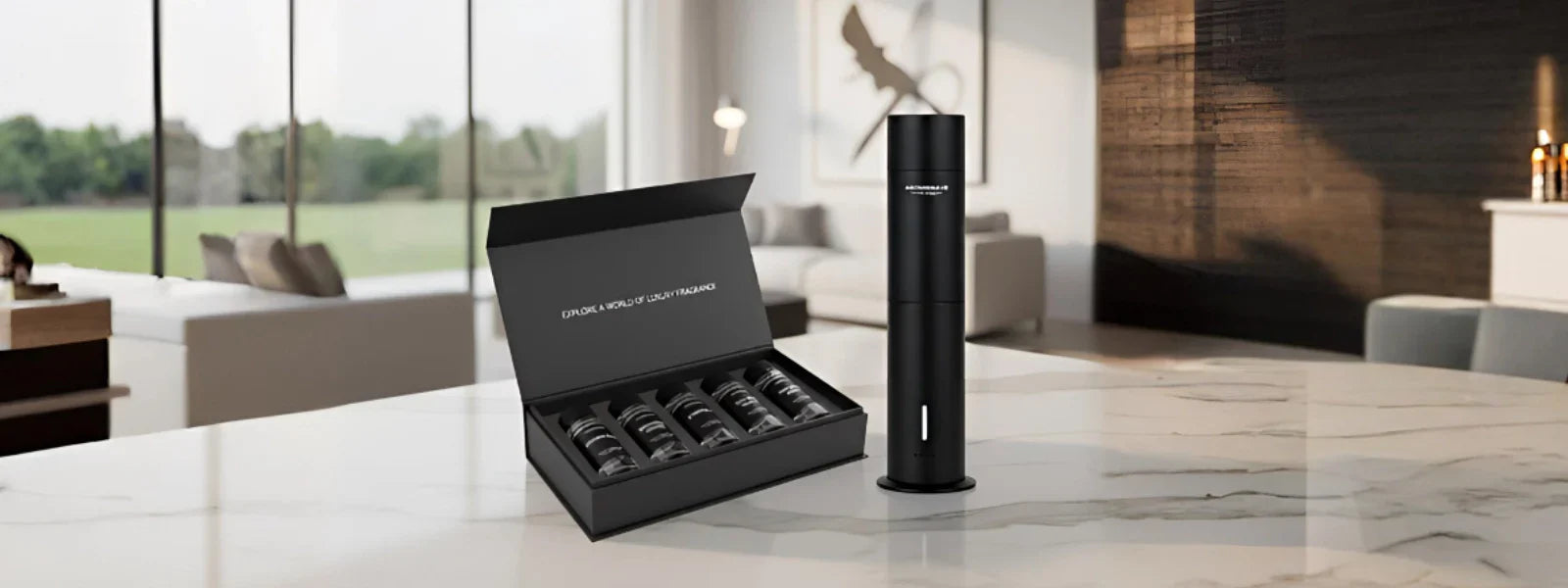
The Aromawave hotel-inspired fragrance oil collection brings the scent atmosphere of the world's finest hotels into Australian homes. Explore 19 hotel-inspired oils, 5 Wellness Edition oils, and 3 Perfume Inspired oils, each crafted for cold air diffusion.
Scent Families and the Emotional Atmospheres They Create
Research in aromachology, the scientific study of how scent affects mood, behaviour, and emotional states, has found that different fragrance families are consistently associated with particular emotional atmospheres across a wide range of individuals. These associations are partly biological and partly cultural, shaped by the shared fragrance experiences of the societies in which we grow up.
The following describes the atmospheric character that research has associated with the major fragrance families, along with the Aromawave oils that most directly represent each character profile. All Aromawave oils are luxury fragrance products. The atmospheric associations described below reflect the general scent character of each oil, not any claimed functional benefit.
| Scent Family | Atmospheric Character | Aromawave Oils in This Family |
| Oceanic and Aquatic | Spacious, fresh, open, calm. Associated with coastal and outdoor environments. | Coastal Escape, Ocean Palm, Fresh Rain |
| Warm Woody and Amber | Grounding, warm, considered. Creates depth and a sense of permanent, settled comfort. | Sky Dream, Dream Rise, The One Haven |
| Rich Oud and Resinous | Deep, immersive, sophisticated. Suggests luxury, permanence, and presence. | Oud Shadow, Golden Oud, Starfall, Midnight Grove |
| Floral and Bloom | Elegant, refined, beautiful. Widely associated with a sense of care and considered atmosphere. | Twilight Rose, W Haven, London Rise |
| Clean and White Tea | Fresh, welcoming, broadly appealing. Creates an immediate sense of quality and attention to detail. | Grand Lobby, Harbor, California Breeze |
| Vivid and Vibrant | Bold, distinctive, memorable. Creates a strong sense of personality and presence in a space. | New York Soul, Sunset Allure, Black Eden |
| Botanical and Herbal | Serene, natural, quietly considered. Reminiscent of open environments, gardens, and the natural world. | Peaceful, Tranquil, Zen |
The Psychology of a Signature Scent: Why Consistency Matters
Research in olfactory psychology has found that repeated exposure to the same fragrance in the same environment can create increasingly strong memory and emotional associations over time. With consistent use, a fragrance may begin to feel like part of how that space is experienced and remembered. Over time, it can become the scent of your home in the same way that certain sounds, textures, and visual details become its recognisable character.
Neuroscience researcher Rachel Herz has described this as odour-evoked autobiographical memory in formation. The scent is not yet a memory trigger for your guests the first time they encounter it. But over repeated visits, it becomes inseparable from their experience of your home and of the time they have spent there. Years later, encountering a similar fragrance in an entirely different setting can bring back the memory of your home with a vividness that no photograph or description could match.
This is why choosing a signature fragrance for your home is such a meaningful decision. You are not just selecting something that smells pleasant. You are choosing what your home will smell like in the memories of everyone who has ever been in it. To explore how to identify and commit to the right signature scent for your Australian home, read our complete guide to choosing a signature home scent.
Why the Method of Fragrance Delivery Matters Psychologically
From a psychological and sensory perspective, the method by which a fragrance is delivered into a space has a significant impact on how it is experienced and what associations it forms. Research in ambient scenting has found that consistent, low-level ambient fragrance, delivered evenly throughout a space, creates the strongest positive associations with a room. Intermittent or inconsistent fragrance, by contrast, draws attention to its source rather than contributing to the ambient character of the space.
Cold air diffusion disperses fragrance as a dry, ultra-fine mist throughout the room, creating a consistent ambient scent experience without using a flame. Many premium scenting environments prefer this style of delivery for its even and continuous presence. It uses no water and applies no heat to the fragrance oil, which Aromawave considers important to maintaining the character and quality of each fragrance as it was designed.
A rich, consistent fragrance environment may help create stronger and more memorable associations than one that feels diluted, inconsistent, or fleeting. This is one of the reasons why luxury hotels, which invest substantially in the psychology of their guest experience, tend to prefer cold air diffusion systems for their scenting environments.
To understand exactly how cold air diffusion technology works and why it is Aromawave's preferred delivery method for fragrance, read our complete guide to cold air diffusion technology.
Five Practical Takeaways From Scent Psychology for Your Australian Home
Choose your home's fragrance character deliberately
Research shows that first impressions of a space are heavily influenced by its scent. Deliberately choosing a fragrance that reflects the character and atmosphere you want your home to convey is one of the most powerful and underutilised aspects of home design. Your fragrance is not a finishing touch. It is part of the fundamental sensory identity of your space.
Use the same oil consistently to build memory associations
The psychology of scent-based memory formation depends on consistency. A fragrance run daily in the same space over weeks and months creates progressively stronger associations with that space and the experiences within it. Rotating oils frequently in your main living areas prevents this depth of association from forming. Choose one signature oil for your home's primary spaces and let it become inseparable from the experience of being there.
Match fragrance character to the room's intended atmosphere
Because different fragrance families create different emotional atmospheres, matching the character of your chosen oil to the intended purpose of a room amplifies the effect. An open, aquatic profile suits an entryway or living area where you want an immediate sense of freshness and welcome. A warm, resinous profile suits a study or private sitting room where depth and settled comfort are the goal. A clean, light profile suits a bedroom or bathroom where clarity and ease are most appropriate. For specific room-by-room oil recommendations, see our complete room-by-room fragrance guide.
Let the diffuser run before guests arrive
The psychological impact of a home's fragrance is strongest at the moment of arrival. Use the programmable scheduling feature on your diffuser to begin running 20 to 30 minutes before guests arrive so the fragrance is fully established in the room air when they walk in. The first impression formed by a beautifully scented room is one of the most powerful and lasting impressions your home can make. Like hotel operators who ensure their lobby scent is at its best before guests check in, timing your diffusion to the arrival moment amplifies its effect considerably.
Choose complexity over simplicity for lasting impression
Olfactory psychology research has found that more distinctive and complex scents create stronger memory associations than simple or generic ones. A fragrance with multiple layered notes, a distinctive top note, a characteristic heart, and a lasting base, will create a more memorable and emotionally resonant home atmosphere than a flat or generic scent. This is why hotel signature fragrances are always multi-layered compositions rather than single-note profiles, and why the Aromawave collection is built around complex, hotel-quality fragrance profiles rather than simple single-note oils.
Frequently Asked Questions
Why is scent the most powerful sense for triggering memories?
Research in neuroscience suggests that smell has a particularly distinctive neurological pathway to brain regions involved in memory and emotion. This helps explain why a fragrance can create an emotional and memory response that feels immediate and often involuntary. Scent-triggered memories have also been observed in various studies to be more emotionally vivid and to persist over time compared to memories triggered by other senses.
What is the Proust Effect in psychology?
The Proust Effect, named after French author Marcel Proust, describes the phenomenon by which a specific scent involuntarily triggers a vivid autobiographical memory, often accompanied by a strong emotional response. Proust described the experience in his novel when the smell of a madeleine cake dipped in tea instantly transported him back to his childhood. Neuroscience has confirmed that this is a real and documented phenomenon rooted in the direct neurological connection between the olfactory bulb and the brain's memory and emotion centres. Scent-evoked autobiographical memories tend to be more vivid, more emotionally charged, and longer-lasting than memories triggered by other senses.
Does the scent of a room affect how it is perceived psychologically?
Yes. Research in environmental psychology and architectural design has found that the ambient scent of a space affects not just how pleasant it feels but how its physical qualities are perceived, including perceived temperature, scale, and sense of comfort. Studies have found that scented environments are consistently perceived as more welcoming, more premium, and more considered than identical unscented environments. This is why hotels, luxury retail stores, and premium hospitality venues invest in their scent environments as a core element of the overall experience they create for guests and customers.
Why do luxury hotels invest in a signature scent?
Luxury hotels use signature scents because the psychology of olfaction makes scent one of the most powerful and lasting tools available for shaping a guest's experience. A consistent, beautifully designed fragrance running through a hotel's lobby and corridors creates an immediate first impression, shapes the emotional atmosphere of the space, and forms a strong autobiographical memory association in guests. Long after a stay, encountering a similar fragrance can instantly recall the experience of that hotel. This is why the world's leading hotel brands, from the Westin to the Ritz Carlton to the Four Seasons, invest significantly in their scent identity as part of their overall brand experience. For a complete guide to what famous hotels actually smell like, read our hotel scent guide.
What is aromachology and how is it different from aromatherapy?
Aromachology is the scientific study of how scent affects human mood, behaviour, and emotional states. It is an academic field that draws on neuroscience, psychology, and sensory research to understand how fragrance influences human experience. Aromatherapy is a broader wellness practice that uses fragrant substances in various ways. Research in aromachology has established that different fragrance families are consistently associated with different emotional atmospheric qualities across large population groups. This research informs how luxury hotels, premium retail brands, and sophisticated home fragrance users think about and choose the scents they use in their spaces.
How long does it take for a home's fragrance to create lasting memory associations?
Memory associations with a home's fragrance can begin forming from early exposures. Research on odour-evoked autobiographical memory suggests that with repeated exposure over time, a consistent fragrance can become strongly associated with a space and the experiences within it. This is one of the key reasons why consistency of fragrance choice matters for those who want to create a genuine sensory identity for their home.
Your Home Has a Scent. The Question Is Whether You Chose It.
Research in neuroscience and psychology strongly suggests that scent is one of the most emotionally powerful and memory-linked human senses. The fragrance of a space can shape how it is perceived by those who enter it, how it is remembered by those who spend time in it, and the emotional associations it may carry long afterwards. Most Australian homes have a scent. Very few of them chose it deliberately.
The Aromawave collection of hotel-inspired, Wellness Edition, and Perfume Inspired fragrance oils is built around the same quality of fragrance used by the world's finest hotels to create their extraordinary sensory atmospheres. Each oil is a luxury fragrance product designed to make your home smell genuinely extraordinary, and to create the kind of rich sensory environment where beautiful memories are made.
Explore the complete collection at aromawave.com.au. Free Australia-wide tracked shipping on all orders over $99. To start with a single oil perfectly matched to your home's character, read our guide to choosing your signature home scent.
Shop the Aromawave Collection