
How Many Square Metres Does a Cold Air Diffuser Cover? The Complete Australian Guide
Aromawave Editorial • Buyer's Guide • Australia
Both Aromawave cold air scent diffusers cover up to 100 square metres from a single unit. This guide explains exactly what that means for every room type and home layout across Australia, and what affects coverage in practice.
Coverage area is one of the most searched questions when buying a cold air scent diffuser. The number on the spec sheet is a starting point, not the whole picture. How much space your diffuser actually covers depends on the room layout, ceiling height, placement position, intensity setting, and whether the space is open-plan or compartmentalised. If you are new to cold air diffusion, the cold air scent diffuser 101 guide covers the full technology overview before diving into coverage specifics. This guide covers all of it, with real Australian room sizes as the reference point throughout.
What does 100 square metres actually look like in an Australian home?
The 100m² coverage figure becomes meaningful when you compare it to the actual size of rooms in Australian homes. Average Australian room sizes are well documented and give a clear picture of how far a single Aromawave diffuser reaches across a typical household.
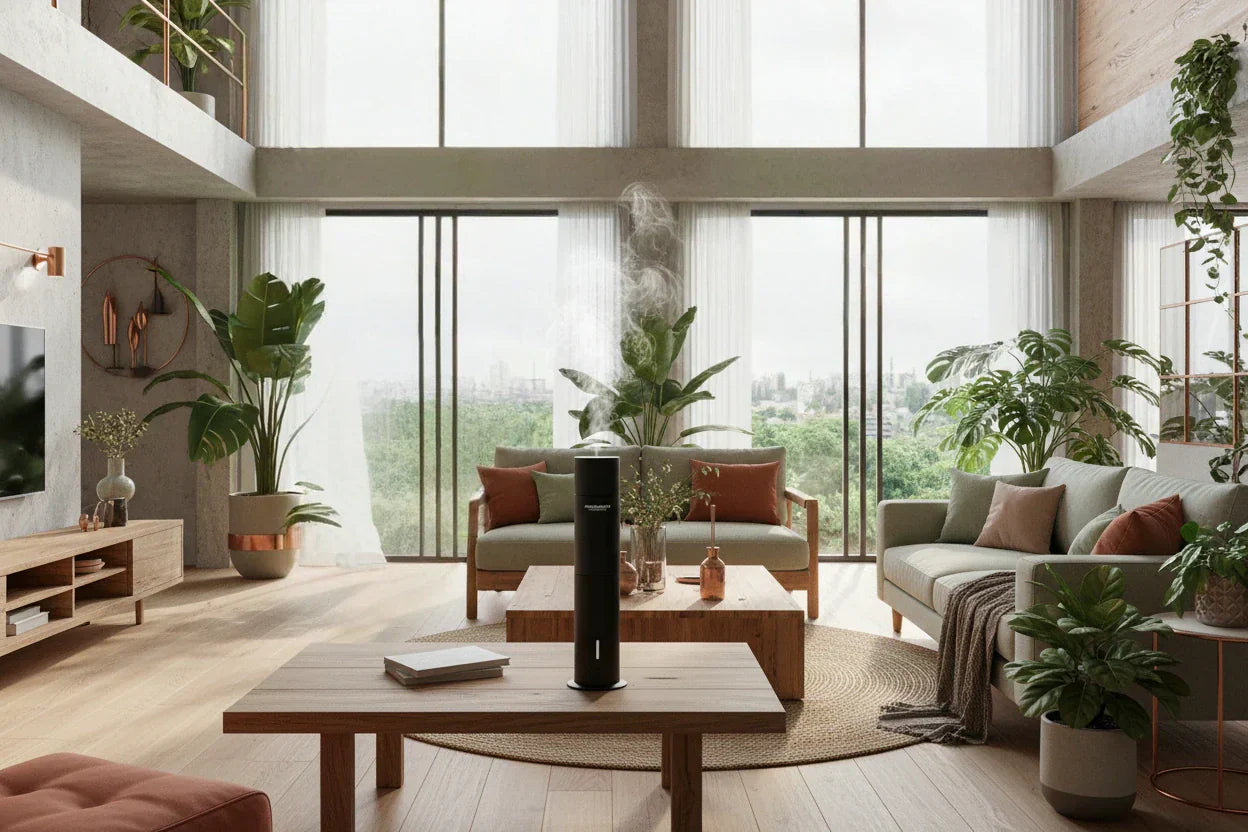
The most common use case for an Aromawave diffuser in an Australian home. The combined open-plan ground floor of a new house or townhouse typically spans 50 to 80 square metres. A single diffuser placed centrally covers this entire zone from one position on a mid-range intensity setting.
A separate enclosed living room in an established Australian home typically measures 20 to 30 square metres. A single diffuser covers this space comfortably at intensity level 1 or 2, often with fragrance reaching adjoining hallways through doorways.
The average Australian master bedroom is 14 to 18 square metres. A diffuser placed on a bedside table or dresser at intensity level 1 fills this space fully. At level 2 or above in a bedroom of this size, the fragrance presence becomes quite forward.
Secondary bedrooms in Australian homes typically measure 10 to 12 square metres. A diffuser at the lowest intensity setting fills this space. Given the small volume of air, intensity level 1 is the appropriate starting point.
A dedicated home office or study in an Australian home typically runs 10 to 15 square metres. A diffuser at level 1 or 2 covers this space well and can be scheduled to run during working hours automatically via the Bluetooth app.
Entrance halls in Australian homes vary widely, from narrow corridors in apartments to generous foyers in larger homes. Even at the lower end of intensity, a diffuser placed on a console table in the entrance creates a fragrance atmosphere that extends into adjoining open spaces.
The average total internal floor area of an Australian house is approximately 230 to 250 square metres across multiple floors and rooms. A single Aromawave diffuser covers 100 square metres of that, which typically equates to the full open-plan ground floor zone or any complete floor of a standard Australian apartment.
What factors affect how much area a cold air diffuser actually covers?
The 100m² coverage figure is measured under standard conditions. Real-world coverage in your specific home depends on five variables. Understanding these helps you place the diffuser correctly and choose the right intensity setting from the first day of use.
Coverage is stated in square metres, but fragrance fills a volume of air, not a floor area. A room with a 2.4m ceiling contains significantly less air volume per square metre than a room with a 3m or 3.6m ceiling. In Australian homes with higher ceilings : double-height entries, vaulted living areas, or older Victorian-era homes : the same diffuser covers the same floor area but takes longer to build up a fragrance presence and may benefit from a higher intensity setting.
Open-plan spaces allow fragrance to circulate freely across the full zone from a single central point. Closed rooms concentrate the fragrance more quickly in a smaller air volume. A diffuser in a closed bedroom reaches a noticeable fragrance level faster than the same diffuser in an open-plan space of the same floor area. For compartmentalised homes with individual closed rooms, a single diffuser placed in the main living area will not reach closed bedrooms or studies.
Central placement achieves more even coverage than wall placement in open-plan spaces. A diffuser placed on a coffee table or kitchen island in the centre of an open-plan zone disperses fragrance evenly in all directions. A diffuser placed against a wall directs more fragrance toward the centre of the room and less toward the wall. For maximum even coverage across 100 square metres, central positioning is preferable. This is one of the reasons the Wireless Ultra Smart Scent Diffuser, which operates cordlessly, suits open-plan Australian homes particularly well. For a full comparison of wired vs wireless coverage and placement, see the wired vs wireless scent diffuser guide.
Both Aromawave diffusers have four intensity settings adjustable via Bluetooth app or remote. Higher intensity settings increase the volume of fragrance oil dispersed per cycle, which builds up fragrance presence faster and sustains it more strongly across a larger area. Lower settings produce a subtler, more background fragrance that suits smaller rooms and enclosed spaces. The right intensity for your specific room and preference is something you dial in over the first few days of use.
Open windows, ceiling fans, split system air conditioners, and ducted HVAC systems all affect how fragrance disperses through a space. Good airflow can help carry fragrance through an open-plan zone more evenly. Heavy ventilation : such as an open window with a crosswind : can dilute fragrance faster than the diffuser can maintain it. In Australian homes with strong airflow from cooling systems in summer, a slightly higher intensity setting may be appropriate.
Does a cold air diffuser cover multiple rooms at once?
This depends entirely on whether the rooms are open to each other or separated by closed doors.
When rooms flow into each other without closed doors : as is standard in most new Australian homes : a single diffuser placed centrally can cover the entire connected zone. The combined kitchen, dining, and living area of a typical new build open-plan ground floor (50 to 80m²) is well within the 100m² coverage range from one central position.
Fragrance from a diffuser in an open living area will naturally reach an adjacent open hallway. The scent presence will be lighter in the hallway than in the primary room, but it will carry through open doorways and across open thresholds without obstruction.
A cold air diffuser in the living area will not reach closed bedrooms or studies. Closed doors prevent fragrance from passing through. If you want a fragrance atmosphere in a bedroom as well as the main living area, a second diffuser in that room : or moving the wireless model between spaces : is the practical solution.
How does ceiling height affect diffuser coverage in Australian homes?
Standard ceiling heights in Australian homes vary by era and type of construction. Understanding how ceiling height interacts with coverage helps you set the right intensity from the start. For more on how Australian home types, layouts, and climate affect diffuser performance, see the guide to cold air diffusers in Australian homes.
The most common ceiling height in Australian homes built since the 1980s. At this height, a room measuring 10m x 10m (100m²) contains 240 cubic metres of air. The Aromawave diffusers reach stated coverage comfortably at mid-range intensity in rooms with standard 2.4m ceilings.
Common in new build premium homes, townhouses, and renovated properties. At 3m ceiling height, the same 100m² floor area contains 300 cubic metres of air. The diffuser covers the same floor area but takes slightly longer to build up fragrance presence and may benefit from intensity level 3 rather than level 2.
Found in contemporary architectural homes and some Federation and Victorian properties. Double-height spaces (4m to 6m) significantly increase the volume of air above breathing level. In these spaces, the practical fragrance coverage at breathing height may be similar to standard rooms, as the diffuser output concentrates in the lower two metres of the space before gradually rising.
Most apartments built in Australia have 2.4m to 2.7m ceilings. Given that most Australian apartments range from 50 to 90 square metres of total floor area, a single Aromawave diffuser covers the entire internal floor area of a typical apartment. For a detailed guide to diffusers in apartment and small space settings, see the cold air diffusers in apartments and small spaces guide, including the open-plan living zone and reaching into open corridors.
Coverage by Australian home type: how many diffusers do you need?
A single diffuser placed centrally in the main living zone covers the full floor area and reaches all open areas. One diffuser is sufficient for the entire apartment given the open layout and total floor area well under 100m².
One diffuser in the main open-plan zone covers the living area. If a fragrance atmosphere is also desired in the bedrooms, a second diffuser or the Wireless Ultra Smart Scent Diffuser moved between rooms provides coverage in closed bedroom spaces.
One diffuser covers the full open-plan kitchen, dining, and living zone. Bedrooms are on a separate level or wing with closed doors. Most households use one diffuser for the main living floor and optionally a second in the master bedroom or primary bedroom area.
Two diffusers are typically the most practical approach: one for the open-plan ground floor zone and one for the upper floor or master bedroom zone. With the Wireless Ultra Smart Scent Diffuser, some households move a single device between the main living floor and bedroom floor as needed, given its cordless design.
For retail stores, salons, showrooms, and commercial reception areas up to 100m², a single Aromawave diffuser covers the space. For larger commercial premises, zoned coverage with multiple units placed throughout the space is the appropriate approach. Full commercial scenting details are available at the business scenting collection.
How do the four intensity levels affect coverage and fragrance presence?
Both Aromawave cold air scent diffusers have four intensity levels adjustable via the Bluetooth app and included remote control. Intensity does not change the coverage area specification : it changes how quickly fragrance builds up and how pronounced the fragrance atmosphere is at any given moment within that covered space.
Subtle background fragrance. Suited to bedrooms, studies, and small enclosed rooms. Also appropriate for first use in any room while you gauge the right level for your space.
A noticeable but not dominant fragrance presence. The most common setting for open-plan living areas in Australian homes. Fragrance is clear without being the first thing that demands attention when entering a room.
A confident, present fragrance atmosphere. Suited to large open-plan zones over 70m², spaces with high ceilings, rooms with strong airflow from HVAC systems, or outdoor entertaining areas where fragrance disperses quickly.
Maximum output. Suited to commercial premises, very large open-plan zones, or initial saturation of a new space. Most residential households use levels 1 to 3 for daily operation and reserve level 4 for entertaining or filling a space quickly before guests arrive.
Once you have confirmed your diffuser covers the right zone in your home, pairing the right fragrance with each room makes the most of the coverage. The best fragrance for every room in an Australian home guide covers oil selection by room type in detail.
Where should you place a diffuser for maximum coverage?
Placement position significantly affects how evenly fragrance distributes across the covered area. These placement principles apply to Australian homes across all common layouts.
The optimal placement for any room is elevated (on a sideboard, table, or shelf) and as central as possible within the zone being scented. Elevated placement allows fragrance to disperse downward and outward. Central placement allows even dispersal in all directions without one area receiving more fragrance than another.
Avoid placing the diffuser directly in front of a split system air conditioner outlet, directly beneath a ceiling fan at high speed, or directly in front of an open window with a strong cross-breeze. Strong direct airflow can push fragrance away from the intended coverage zone before it disperses evenly.
Placing the diffuser at 80cm to 120cm above floor level : table or sideboard height : allows the dry micro-mist to disperse into the breathing zone of the room before settling. A diffuser placed directly on the floor loses some of its dispersal efficiency as the mist rises from ground level rather than from a position already within the inhabited air volume of the room.
The Wireless Ultra Smart Scent Diffuser's cordless design allows placement at the centre of an open-plan space : on a kitchen island, dining table, or central coffee table : where maximum even coverage across the full zone is achieved. Wired models placed near a wall power point still cover the full 100m² specification but may create a slightly stronger fragrance presence toward the centre of the room than near the wall behind the unit.
When do you need a second diffuser in an Australian home?
One diffuser covers up to 100m² of open connected space. A second diffuser is worth considering in three scenarios specific to Australian homes.
The first is a two-storey home where the ground floor open-plan zone and the upper floor bedroom zone are separately enclosed. A single diffuser on the ground floor does not reach the upper floor through a closed staircase. Two diffusers : one per floor : is the practical approach for whole-home coverage.
The second is a large single-storey home where the total open floor area exceeds 100m². Some larger Australian homes have combined open-plan living areas approaching or exceeding 100 square metres. In these cases, a second diffuser positioned toward the opposite end of the open zone creates more even coverage across the full space than a single unit attempting to cover beyond its specification.
The third is a home where a fragrance atmosphere is wanted in both the main living area and in a specific closed room such as the master bedroom. For a full comparison of the two Aromawave home diffuser models including coverage, specs, and which suits different Australian homes, see the best cold air diffuser for Australian homes guide. A second diffuser, or the Wireless Ultra Smart Scent Diffuser moved between rooms as part of a daily routine, solves this simply.
The Wireless Ultra Smart Scent Diffuser operates on a rechargeable battery and can be moved between rooms without any setup. Some households use one Wireless Ultra Smart Scent Diffuser in the living area during the day and move it to the bedroom in the evening, managing the full home with a single device. All details at Aromawave.
Frequently asked questions: cold air diffuser coverage in Australia
How many square metres does a cold air diffuser cover?
The Aromawave Ultra Pro Scent Diffuser and Wireless Ultra Smart Scent Diffuser both cover spaces up to 100 square metres from a single unit using cold air diffusion technology. In Australian homes, 100 square metres equates to the full open-plan ground floor of a typical new build home, the complete internal floor area of most Australian apartments, or any individual room in an Australian home several times over. Both models are adjustable across four intensity levels via Bluetooth app and remote control to suit spaces of different sizes within the 100m² maximum.
Is 100 square metres enough for an open-plan Australian home?
Yes, for most Australian open-plan homes. The combined kitchen, dining, and living area of a new build Australian home typically spans 50 to 80 square metres. A single Aromawave diffuser placed centrally covers this entire zone from one position. For very large open-plan spaces approaching or exceeding 100 square metres : found in some premium homes : a second diffuser positioned at the opposite end of the zone provides more even coverage across the full area.
Can one diffuser cover an entire apartment in Australia?
In most cases, yes. The average Australian apartment ranges from 50 to 90 square metres of total internal floor area. A single Aromawave diffuser at mid-range intensity covers the full floor area of a standard Australian apartment. For apartments with fully closed-off bedrooms, the fragrance will be strongest in the main open-plan living zone and lighter in closed rooms unless the bedroom door is left open or a second diffuser is placed in the bedroom.
Does ceiling height affect how much area a cold air diffuser covers?
Ceiling height affects the volume of air the diffuser needs to fill, which in turn affects how quickly fragrance builds up and how pronounced the atmosphere is at a given intensity setting. The 100m² coverage specification is measured at standard ceiling heights. Rooms with higher ceilings of 3m or above contain more air volume per square metre of floor area. In these rooms, a slightly higher intensity setting may be needed to achieve the same fragrance presence as in a room with a standard 2.4m ceiling.
How many diffusers do I need for a two-storey Australian home?
Most two-storey Australian homes are best served by two diffusers: one for the open-plan ground floor zone and one for the upper floor bedroom zone. A single diffuser on the ground floor will not reach closed upper-floor bedrooms through a staircase and closed doors. Alternatively, the Wireless Ultra Smart Scent Diffuser can be moved between the main living floor and the upper floor as part of a daily routine, managing the home with a single cordless device.
Does a cold air diffuser reach closed rooms through doorways?
Fragrance from a cold air diffuser does not pass through closed doors in meaningful concentrations. Open doorways and open-plan connections allow fragrance to flow from the primary room into adjacent spaces naturally. For a fragrance atmosphere in a closed bedroom or study, the most practical options are placing a second diffuser in that room, leaving the door ajar, or using the Wireless Ultra Smart Scent Diffuser and moving it between rooms as desired. The full diffuser range is available at Aromawave.
What intensity setting should I use in a large open-plan living area?
For most Australian open-plan living areas between 50 and 80 square metres with a standard 2.4m ceiling, intensity level 2 is a good starting point. If the space has high ceilings, strong airflow from air conditioning, or approaches 100 square metres in floor area, intensity level 3 is more appropriate. Both Aromawave diffusers allow you to adjust intensity settings remotely via the Bluetooth app without physically accessing the device, so dialling in the right level for your specific space takes only a few days of use.
Where is the best place to put a cold air diffuser for maximum coverage?
The optimal placement is elevated at table or sideboard height, positioned as centrally as possible within the space being scented, and away from direct airflow sources such as split system outlets or ceiling fans. In open-plan homes, central placement on a kitchen island, dining table, or central coffee table gives the most even fragrance distribution across the full zone. The Wireless Ultra Smart Scent Diffuser is particularly suited to central placement as it operates without cables and can be positioned anywhere without considering nearby power points.
Up to 100 square metres. One device. Every room in your Australian home.
Ultra Pro Scent Diffuser $199 • Wireless Ultra Smart Scent Diffuser $249
4 intensity levels • Bluetooth app + remote • Cold air diffusion • 4 colours
Free tracked delivery on orders over $99 • Australia Post • 30-day returns
Free AU shipping on orders over $99 • 30-day returns • 12-month warranty • ABN 70 681 300 363
Aromawave™ is an independent Australian brand and is neither affiliated with, authorised by, nor endorsed by any hotel group, perfume brand, fragrance house, or their respective affiliates. Any third-party brand or hotel names referenced in this guide are used solely for descriptive and comparative purposes to indicate fragrance atmosphere inspiration. All trademarks remain the exclusive property of their respective owners.